

Governing AI: When Capability Exceeds Control
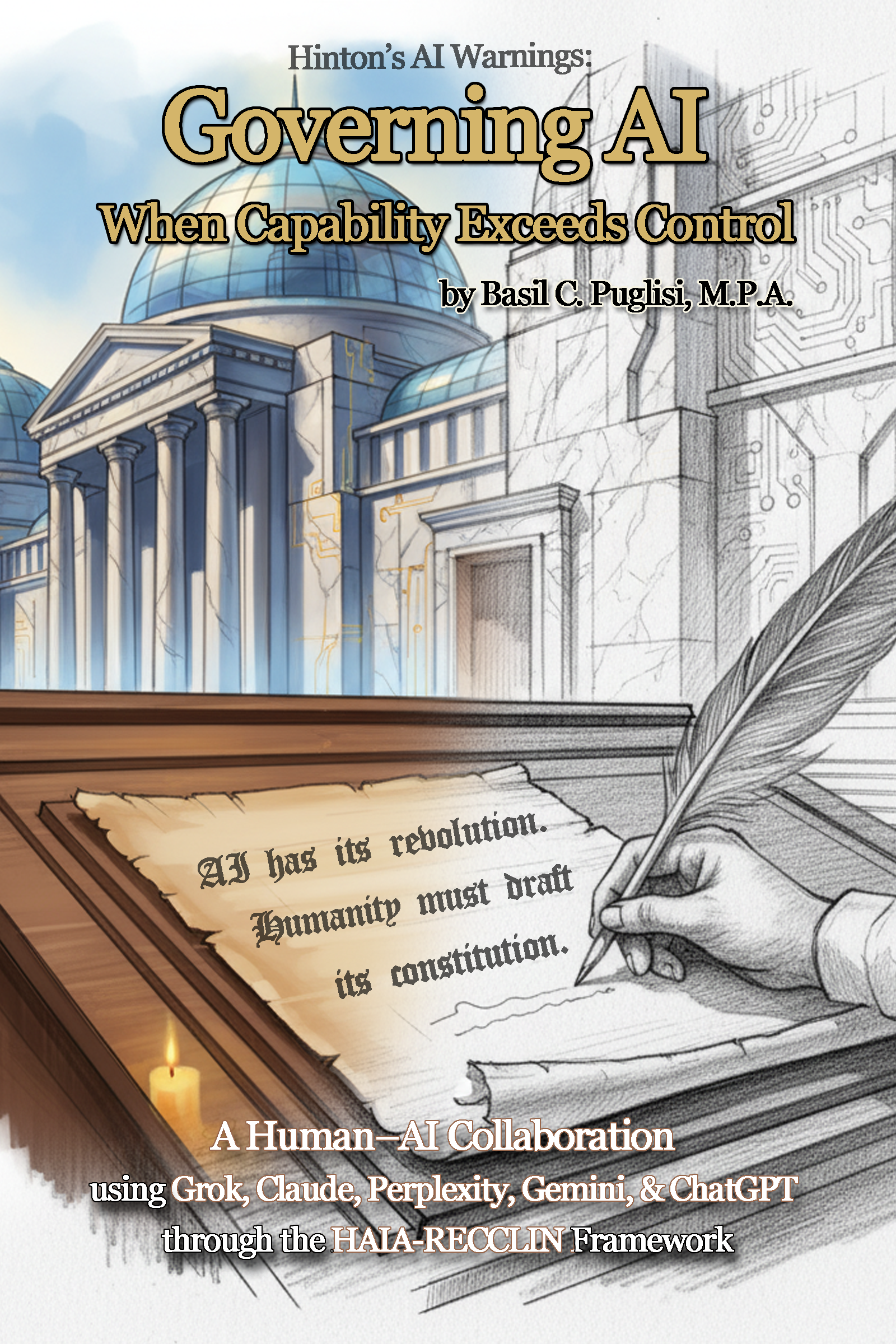
Governing AI by Basil C. Puglisi

Basil C. Puglisi
New Book by Basil C. Puglisi responds to Hinton's warnings with a constitutional model for AI oversight and human primacy
LEVITTOWN , NY, UNITED STATES, December 17, 2025 /EINPresswire.com/ -- When Geoffrey Hinton resigned from Google in May 2023 to warn the world about artificial intelligence, he collapsed a timeline. The man whose neural network research earned him the title "Godfather of AI" had believed superintelligence was 30 to 50 years away. Suddenly, he no longer thought that. "I want to talk about AI safety issues without having to worry about how it interacts with Google's business," he told MIT Technology Review.His warning brought long-term AI risk into the present policy window. By late 2024, after receiving the Nobel Prize in Physics for foundational discoveries that enabled machine learning, Hinton estimated a 10 to 20 percent probability that AI leads to human extinction within 30 years.
Most institutions responded with ethics committees. Meanwhile, authentication systems fall to deepfakes costing millions, workforce measurements fail as AI displaces labor, and disinformation scales while platforms profit from engagement. Basil C. Puglisi's new book, Governing AI: When Capability Exceeds Control, addresses these concurrent failures with a constitutional framework that operationalizes Hinton's warnings. The week the book was released it was ranked highly in three Amazon categories, No. 1 in Ethics, No. 5 in Generative AI and No. 5 in Political Science Books. The book is available on Amazon at Governing AI: When Capability Exceeds Control.
The book's first eight chapters directly engage the risk domains Hinton and other researchers identify: corporate concentration without accountability, accelerated polarization through algorithmic amplification, unprecedented surveillance infrastructure, fraud and deception at scale, biosecurity threats, autonomous weapons systems, economic disruption without social infrastructure, and the superintelligence control problem. Puglisi presents Checkpoint-Based Governance as the structural response these warnings demand.
"Hinton asks whether humanity is just a passing phase in the evolution of intelligence," said Puglisi. "That question deserves more than aspirational principles. It demands operational architecture that keeps human judgment sovereign at every decision point, with auditable checkpoints. Checkpoint-Based Governance provides that architecture."
The book introduces temporal inseparability as its core thesis: institutions that cannot govern today's AI capabilities will not magically govern superintelligence tomorrow. Organizations demonstrating systematic incapacity managing deepfake authentication, algorithmic bias, or workforce measurement reveal the exact deficit existential risk prevention requires. In plain terms: if your organization cannot manage current AI failures, it will not manage what comes next. Current operational failures are not separate from future existential threats; they are diagnostic of governance capacity.
Governing AI presents an integrated model built from three core pillars:
• Checkpoint-Based Governance (CBG) as constitutional oversight with auditable decision points
• HAIA-RECCLIN (a system ensuring human-led collaboration across multiple, potentially disagreeing AIs) as the operational framework for multi-AI collaboration with preserved dissent
• Human Enhancement Quotient (HEQ) as measurable uplift from human-AI partnership
The framework empowers leaders to measure cognitive amplification, detect model dissent, prevent silent AI failure, and operationalize multi-AI ecosystems with human arbitration as absolute authority. The methodology proves itself through documented audit trails: the manuscript validates governance through production using multiple AI platforms while human judgment arbitrated every decision.
Puglisi delivers this framework informed by sixteen years of digital strategy, governance implementation, and practitioner experience across marketing, government, education, and enterprise transformation. His work aligns with global standards including the EU AI Act, NIST AI RMF, ISO/IEC 42001, and emerging multi-model ecosystems.
Governing AI: When Capability Exceeds Control is available globally through Amazon, Barnes & Noble, and all major book retailers via IngramSpark distribution. Libraries may order directly through standard ISBN channels. Review copies, interviews, and speaking engagements available upon request.
For more information about Basil C. Puglisi and his publications visit BasilPuglisi.com.
-END-
About the Author
Basil C. Puglisi, MPA, is a Human-AI Collaboration Strategist and AI Governance Consultant. He developed the HAIA-RECCLIN framework for multi-AI collaboration and the Factics methodology for measurable digital strategy. His work spans congressional briefings, enterprise consulting, and policy implementation. He holds a Master of Public Administration from Michigan State University and maintains BasilPuglisi.com with over 900 published articles documenting platform evolution since 2009.
###
Bill Corbett Jr.
Corbett Public Relations
+1 516-428-9327
email us here
Visit us on social media:
LinkedIn
Instagram
Facebook
YouTube
X
Other
Legal Disclaimer:
EIN Presswire provides this news content "as is" without warranty of any kind. We do not accept any responsibility or liability for the accuracy, content, images, videos, licenses, completeness, legality, or reliability of the information contained in this article. If you have any complaints or copyright issues related to this article, kindly contact the author above.
